Best Supplement For MemoryVitamins for Brain Memory for Students: Cost and Dose Compared
Vitamins for Brain Memory for Students: Cost and Dose Compared
The short answer
The vitamins most often linked to memory are B vitamins (B6, B9/folate and B12), omega-3 fatty acids (DHA and EPA) and vitamin D, with food as the main source. Their benefit depends on whether you are deficient or eating too little of them. To compare memory vitamins for students, divide the price by the number of days in the bottle and check whether each ingredient is listed at a dose close to the amounts studied.
Some links on this site are affiliate links: if you buy through one, the site may earn a commission at no extra cost to you. More about this.
Based on the product's documentation and what users report, not our own testing. Last checked: 14 November 2026.
You have probably seen student-focused memory supplements promoted with big claims and small print, and it is hard to tell what a bottle actually delivers or what it costs per day of use. Most listings show the price per bottle, which says little about value. A cheap bottle with underdosed ingredients can cost more per useful dose than a pricier one.
This page works through that comparison. It explains how to calculate cost per useful dose, where the label amounts sit against the doses used in research, and where a listing hides more than it reveals.
Along the way it covers how the picks were chosen, which is what each option claims, and what the documentation and user reports do and do not support. The sections are:
- Cost per day: turning a bottle price into a daily figure you can compare.
- Dose check: matching label amounts against the ranges studied for each ingredient.
- Ingredient transparency: spotting blends that hide individual amounts.
- Marketed options: how Phytomem One's documented price and terms compare with other choices.
- Where the evidence stops: what the claims can and cannot support.
Based on the product's documentation and what users report, not our own testing.
Student memory products at a glance
| Option | Best for | Price as stated | Dose disclosed | Key limit |
|---|---|---|---|---|
| B6, B9 (folate) and B12 | Low intake or low status | Not stated | Depends on product | Little benefit if diet is varied |
| Omega-3 (DHA and EPA) | Brain structure support | Not stated | Check per-serving mg | Memory trial results mixed |
| Vitamin D and choline | Confirmed deficiency | Not stated | Check per-serving mg | Deficiency uncommon in well-fed adults |
| Phytomem One | Adults 18 and older | $79 STARTER, $69 ADVANCED, $49 ULTIMATE per bottle | Not stated (proprietary blends) | Cost per useful dose cannot be calculated |
| Ginkgo biloba (herbal) | Older adults, per some trials | Not stated | Not stated | Mixed trial results; interacts with blood thinners |
| Curcumin (herbal) | Lab and animal work only | Not stated | Not stated | Limited human memory data; poor absorption |
| Phosphatidylserine (herbal) | Memory complaints in older adults | Not stated | Often far below studied doses | Products often contain far less than trial doses |
Which nutrients are linked to memory
Most student-marketed memory products are built around a short list of micronutrients. The evidence behind each one differs a lot, so it helps to separate what the biology supports from what the marketing implies.
B6, B9 (folate) and B12 have the clearest mechanistic role in memory. They work together in homocysteine metabolism, where folate and B12 help remethylate homocysteine and B6 supports the transsulfuration pathway. Elevated homocysteine has been associated with cognitive decline, and B-vitamin supplementation lowers it. Nerve function also depends on these B vitamins, B12 in particular for myelin. The caveat matters: benefit in trials is clearest in people with low intake or low status, such as older adults with poor absorption or people on restrictive diets. For a student who already eats a varied diet, a high-dose B complex is unlikely to sharpen recall.
Omega-3 fatty acids (DHA and EPA) have better data for brain structure than for memory performance. DHA is a major structural fat in neural membranes, and observational links between higher fish intake and better brain volume are reasonably consistent. Trials testing omega-3s on memory tests in healthy adults have been mixed, with small effects at best. If you are comparing products, look at the actual DHA and EPA milligrams per serving, not the total "fish oil" or "omega" figure on the front label.
Vitamin D and choline appear in memory products largely for their roles in neural function. Vitamin D receptors are present in brain tissue, and low vitamin D status is common, particularly in winter and in people who spend little time outdoors. Choline is a precursor to acetylcholine and to phosphatidylcholine, a membrane component. In practice, deficiency of either is uncommon in well-fed adults, and a supplement only helps if a blood test or a clear dietary gap shows a shortfall.
Cost per useful dose: how to work out the real price
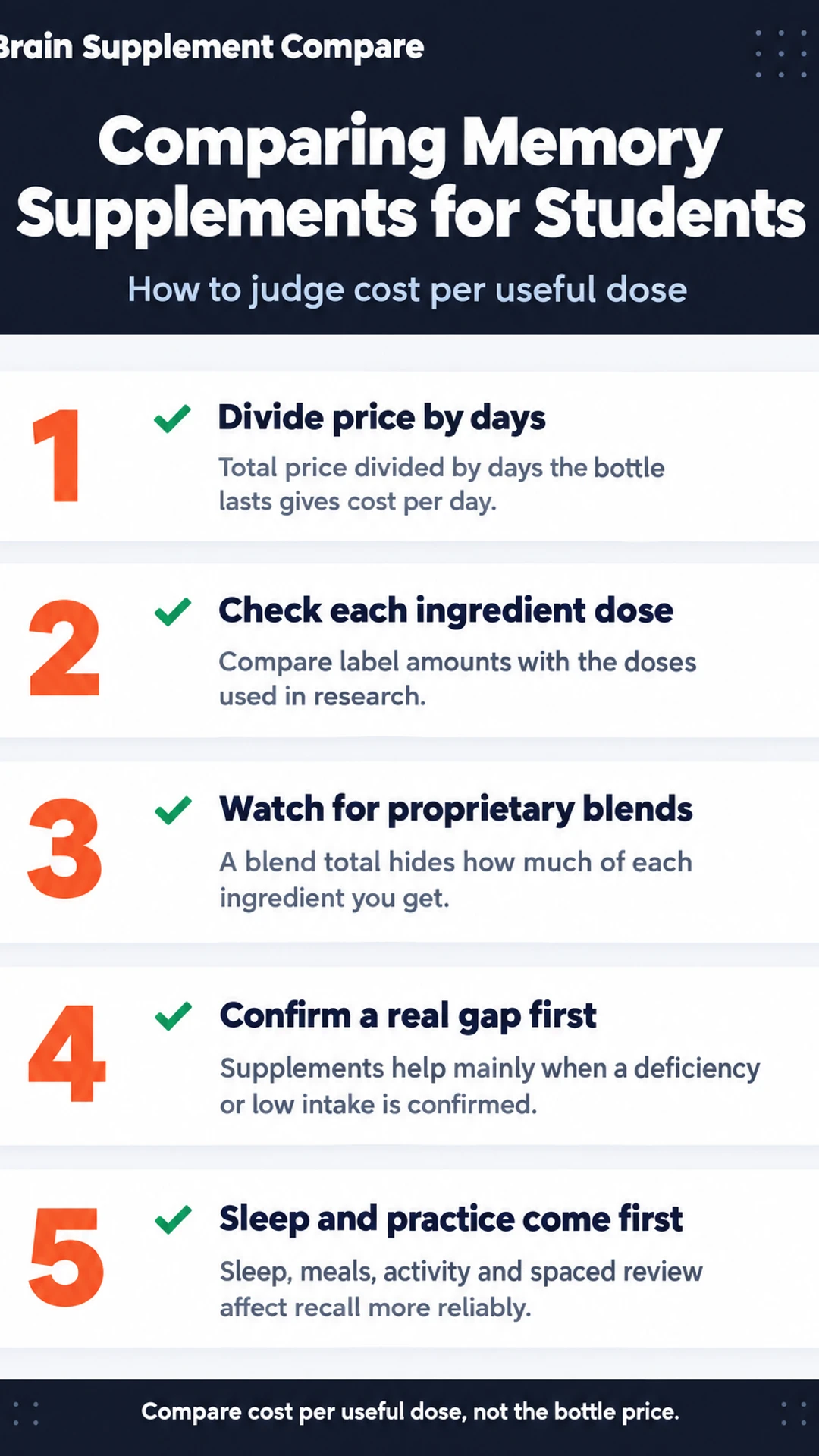
Comparing bottle prices tells you very little. A cheap bottle with a tiny amount of each ingredient can cost more per useful dose than a pricier one, so the sensible unit is cost per day and cost per dose of each researched nutrient.
Start with cost per day. Divide the total price by the number of days the bottle supplies. To get the days, take the number of servings in the container and divide by the number of servings you take daily, using the serving size printed on the label. A 60-serving bottle taken one tablet a day lasts 60 days.
Next, check the dose. For each key ingredient, compare the amount on the label with the amount used in the studies you care about. Count only the ingredients that carry a known dose. Ingredient amounts are not disclosed, according to one reviewer, so there is no weight per ingredient to assess against a dose. An ingredient listed without an amount cannot, however impressive the name.
Flag two things immediately:
- Proprietary blends. Several ingredients are grouped under one total weight, so you cannot tell how much of any single compound you are getting.
- Undisclosed amounts. If the label or sales page gives no per-ingredient figures, the cost per useful dose cannot be calculated at all.
For products in either category, the honest answer is "unknown," not a number you have estimated. Phytomem One, for example, is sold as a 10-ingredient formula, and according to the sales page, the ingredients are grouped by function. That means its cost per useful dose cannot be worked out from the information available. Its price is still worth comparing per day: the STARTER plan works out to $79 per bottle, the ADVANCED plan to $69 per bottle, and the ULTIMATE plan to $49 per bottle, with shipping charged on the STARTER plan.
Reading the label: dose, form and proprietary blends
Start with the serving size. Daily Value is a reference for vitamins and minerals with established intakes. It has no meaning for most botanicals, and a high percentage can hide a very low absolute amount of a nutrient.
Watch for nutrients listed with no amount at all. Some labels print the ingredient name and a proprietary total, but no milligram figure for each component. Check these items on the panel:
- Ingredients listed without an amount beside them
- A "blend" line followed by one total weight
- Amounts shown only as "proprietary" or "not disclosed"
Does the form of the nutrient matter?
Yes, often. Folate (natural food form, or the L-methylfolate supplement) and folic acid (the synthetic form) are not handled identically in the body, and some people convert folic acid poorly. Methylcobalamin and cyanocobalamin are both forms of vitamin B12, but cyanocobalamin needs a conversion step that methylcobalamin skips. The label should name the form. If it only says "B12" or "folate," you cannot tell which one you are buying.
What does a proprietary blend hide?
A blend tells you the total weight of several ingredients together, which makes it impossible to tell whether any single one reaches a dose found in research. Ask the manufacturer for the individual amounts. If they will not provide them, treat the blend as unknown, not as adequate.
Supplements for studying: what students should expect
Before you spend money on a memory product ahead of exams, it helps to be clear about what it can and cannot do. Sleep, regular meals, physical activity and spaced practice, where you revisit material over several days instead of cramming, affect recall far more reliably than most supplements. If you are short on sleep or skipping breakfast, a capsule is unlikely to offset that.
The key question is whether you have a gap in the first place. If you are not deficient in a given nutrient, extra intake is unlikely to change exam performance. Some vitamins also carry risks at high doses, especially when taken alongside other products that contain the same nutrient. Fat-soluble vitamins such as A and D accumulate in the body, so more is not better.
When you compare options, work out the cost per useful dose rather than the price on the bottle. Check the amount of each active ingredient per serving, how many servings a pack contains and whether the dose matches what the evidence supports. A cheap product with a low dose can cost more per effective serving than a pricier one.
Speak to a pharmacist or GP before you start, particularly if you are under 18, take prescription medication or have a known deficiency. They can tell you whether a supplement is appropriate and whether a blood test would be more useful than guessing.
Herbal extracts and plant ingredients in memory products
Most student-marketed memory products mix vitamins with plant extracts, and the plant side is where the label tells you least. Three ingredients appear often enough to be worth understanding.
Ginkgo biloba has the largest body of trials of the three, but the results are mixed. Some trials in older adults show small benefits, while larger and more carefully designed studies have found little or no effect on memory in healthy people. Ginkgo also affects platelet function, which matters for the interaction point below.
Curcumin, the main compound in turmeric, has been studied mainly in lab and animal work. Human data on memory is limited and often comes from small trials. It is also poorly absorbed unless the product uses a formulation designed to improve uptake, and the label rarely tells you which form it contains.
Phosphatidylserine is a phospholipid with some trial evidence for memory complaints in older adults. Those trials used doses in the range of 100 mg per day, and student-focused products often contain far less.
Some practical checks when you read a label:
- Look for the amount of each extract in milligrams, not just its name.
- Check whether the amount matches what was used in the studies behind it.
- Assume a long ingredient list does not mean each item is present in a meaningful dose.
Interactions matter more than the marketing. Ginkgo can add to the effect of blood thinners such as warfarin, aspirin and clopidogrel, and curcumin can do the same. Plant extracts also interact with some antidepressants, diabetes drugs and blood pressure medicines. If you take any prescription medicine, check the full ingredient list with a pharmacist before you buy.
Safety checks and what to do before buying
Start with the questions that decide whether a product is worth opening. For a memory product like Phytomem One, that means checking the things a buyer can verify before paying.
Does the product have independent testing or certification? The sales page says the ingredients are handled under the USDA National Organic Program in a certified facility. Treat that as the vendor's claim until you can see the certificate or the facility name. One reviewer found that ingredient amounts are not disclosed, which matters: without per-ingredient milligrams you cannot compare the formula against studied doses of berberine, cinnamon or saffron. The fact sheet does not show third-party lab results, so none were found.
Can you check the ingredient amounts? If the label gives only a proprietary blend total, you cannot judge whether any single ingredient is at a dose used in research. Ask the vendor for the full label before buying.
What to do before buying:
- Read the refund terms and confirm the window and the process. Phytomem One's page offers a 60-day money-back guarantee and says you email the team to request a refund. Save the order confirmation.
- Check the age rule. The terms say the site is for adults 18 and older.
- Buy only from the official source. One reviewer found imitation products sold online, and the product is sold only on its own page, so anything from another seller is a red flag.
- Speak to a doctor if you take medication or have a health condition, since the page itself advises checking with a doctor when safety is a concern.
Treat recall claims as the vendor's claims. The sales page describes the formula as built for lasting mental clarity, recall and resilience. Those are claims, not results. Independent sources describe the product as gradual rather than a stimulant, and users report better focus after several weeks, but that is anecdote. Results also depend on sleep, nutrition, activity and stress, which the reviewers themselves stressed. Look for controlled human evidence on the specific ingredients before you weigh the claim.
Frequently asked questions
Which vitamins improve memory?
Vitamin B12, folate and vitamin D are the ones most often linked to memory, mainly because deficiencies in them can impair cognition. Supplementing when your levels are normal has not been shown to sharpen recall in healthy adults. A blood test is the practical way to find out whether you are short on any of them.
What do Japanese eat to prevent dementia?
Traditional Japanese diets are built on fish, soy, green tea, seaweed, vegetables and rice, with relatively little red meat and processed food. Studies of Japanese populations have linked this pattern to lower dementia rates, but the research is observational, so it shows association rather than proof of cause. Diet works alongside sleep, activity and blood pressure control.
What does Mayo Clinic recommend for memory?
Mayo Clinic's guidance on memory centers on lifestyle: regular physical activity, enough sleep, managing stress, treating conditions such as high blood pressure, diabetes and depression, and eating a balanced diet. It advises talking to a doctor before taking supplements, because some interact with medications and most have not been shown to improve memory in people without a deficiency.
What foods are good for brain health?
Foods with a good track record include oily fish such as salmon and sardines, leafy greens, berries, nuts, legumes, eggs and whole grains. Olive oil is a common part of the Mediterranean eating pattern, which has been studied in relation to cognitive health. Eating these in place of heavily processed food matters more than any single item.
Are student memory supplements worth the cost?
Usually the cost per useful dose matters more than the price per bottle. Compare how much of a clinically relevant nutrient each serving delivers, then divide by the number of servings. A cheap bottle with a low dose can cost more per useful amount than a pricier product, and a multivitamin may already cover the basics.
Wrapping up
Memory supplements for students are easiest to judge by cost per useful dose, not the price on the label. Most people who are not deficient will not gain recall from extra vitamins, so check your levels and your diet first. If you compare options, look at the amount of each active ingredient per serving and ask a doctor before starting anything. Which memory supplement have you compared, and how did you work out its real cost? Share it in the comments.
Visit the official site to read the Phytomem One offer, including the plans listed there, the 60-day money back guarantee and the ingredient groups the sales page describes.