Best Supplement For Memory12 Best Memory Loss Supplement Options and What Each Can and Cannot Address
12 Best Memory Loss Supplement Options and What Each Can and Cannot Address
The short answer
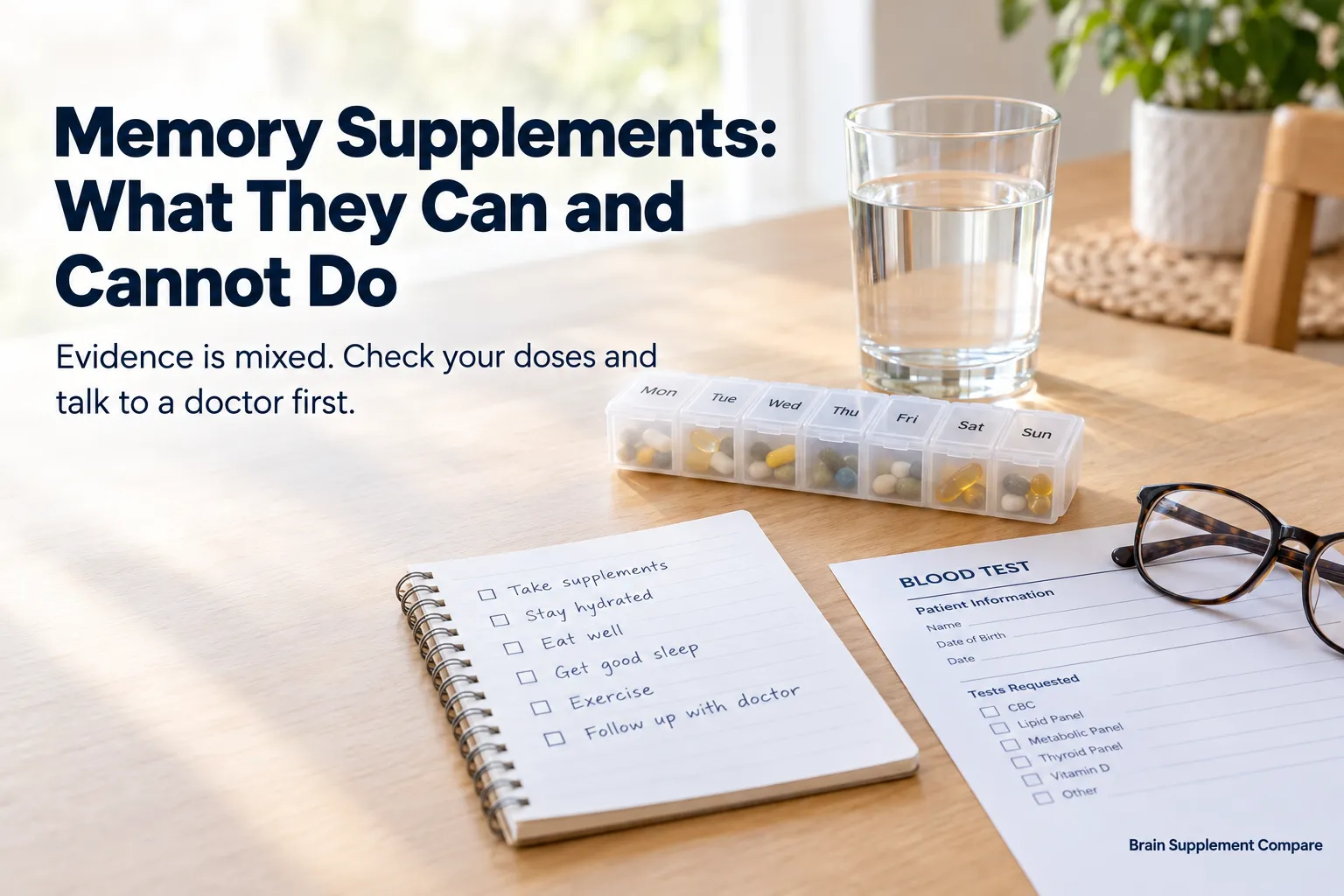
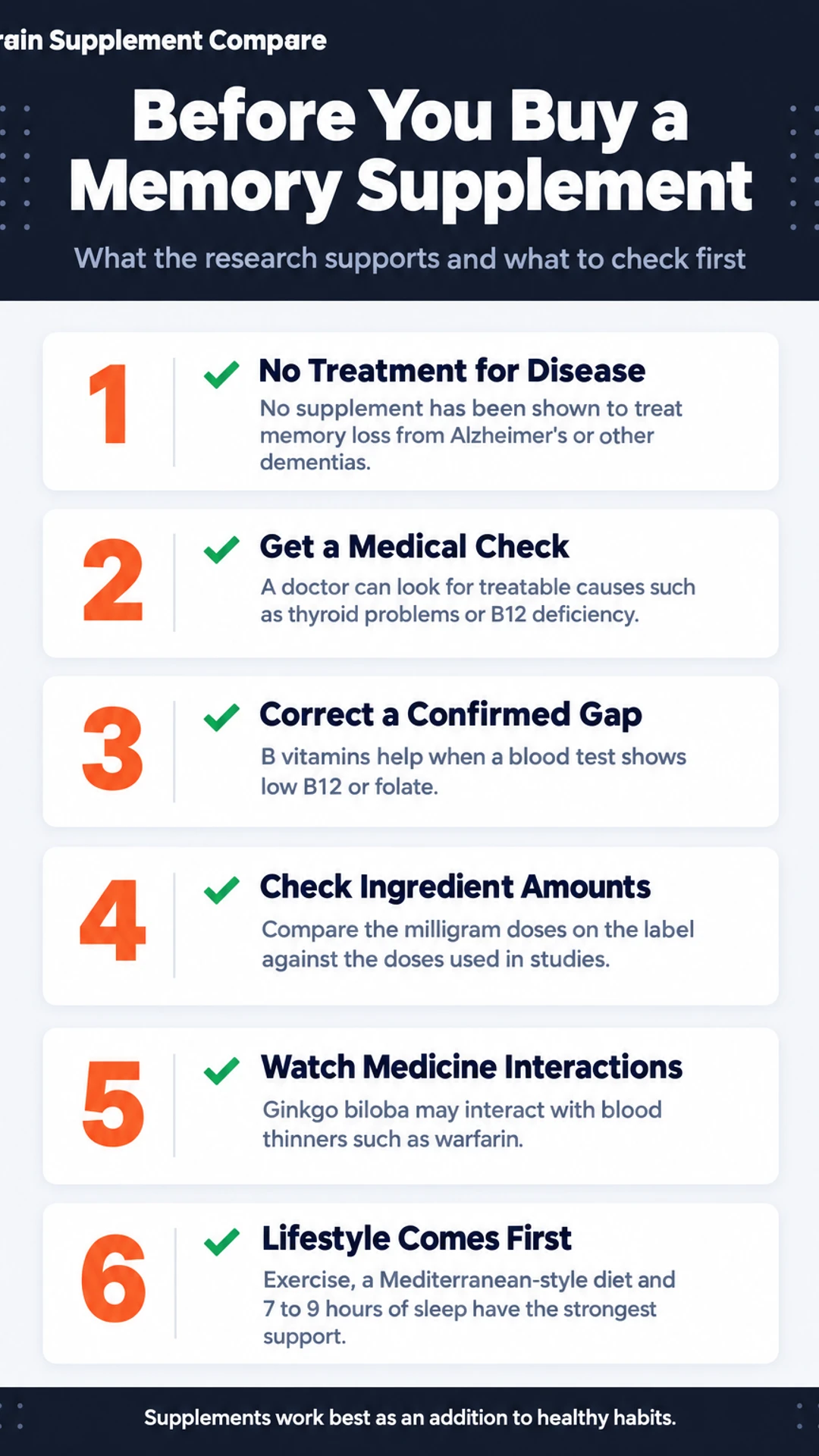
No supplement has been shown to treat memory loss caused by disease such as Alzheimer's or other dementias. Most memory supplements are best suited to everyday forgetfulness or a nutrient gap, and the research on them is mixed to weak. Before buying, check the ingredient amounts, the safety of combining it with your medicines, the trial and refund terms, and whether a doctor has assessed the memory changes.
Some links on this site are affiliate links: if you buy through one, the site may earn a commission at no extra cost to you. More about this.
Based on the product's documentation and what users report, not our own testing. Last checked: 14 November 2026.
This page reviews 12 best memory loss supplement options and sets out what each can and cannot address. The options were chosen by how often they are marketed for memory, how much published research sits behind their main ingredients, and how clearly their labels and terms can be checked. Based on the product's documentation and what users report, not our own testing.
Phytomem One is one of the twelve. Its sales page describes it as a 10-in-1 formula with saffron extract, fucoxanthin, berberine HCl, Ceylon cinnamon and several other botanicals. The vendor says it is sold only on its own website, comes in tablet form, and carries a 60-day money-back guarantee. Ingredient amounts are not disclosed, which makes it harder to compare against single-ingredient products, and the list is covered in detail below.
Let's dive in.
Memory supplement options at a glance
| Option | Best for | Key feature | Price as stated | Trial or refund terms |
|---|---|---|---|---|
| Phytomem One | Not stated | 10-ingredient formula, amounts undisclosed | $49 to $79 per bottle | 60-day money-back guarantee |
| Ginkgo biloba | Not stated | Not stated | Not stated | Not stated |
| B vitamins (folate, B6, B12) | Correcting a confirmed deficiency | Evidence tied to low B12 or folate | Not stated | Not stated |
| Omega-3 fatty acids | Not stated | Not stated | Not stated | Not stated |
| Bacopa monnieri | Not stated | Not stated | Not stated | Not stated |
| Phosphatidylserine and choline forms | Not stated | Alpha-GPC, citicoline, phosphatidylserine | Not stated | Not stated |
| Neuriva | General cognitive function | Daily capsule or chewable | Not stated | Not stated |
| Prevagen | Not stated | Central ingredient apoaequorin | Not stated | Not stated |
A closer look at each
Phytomem One: Based on the product's documentation and what users report, not our own testing. The vendor's sales page describes a 10-ingredient formula, including saffron extract, berberine HCl, Ceylon cinnamon and Morosil, built for lasting mental clarity and recall. It is sold only on its own page, costs $49 to $79 per bottle depending on plan, and carries a 60-day money-back guarantee. One reviewer found the ingredient amounts are not disclosed, so you cannot check the doses against trial data. Results depend on sleep, activity and stress as much as the capsule.
Ginkgo biloba: The most common botanical in this category and the one most studied in memory trials, with mixed results. Large trials in older adults, including the GEM study, did not show that ginkgo prevents dementia. It may interact with blood thinners such as warfarin, so check with a prescriber first if you take one. Ginkgo biloba is a poor fit if you expect a clear, quick change in recall.
B vitamins (folate, B6, B12): A nutrient-based option where the evidence is specific to particular people. If a blood test shows low B12 or folate, correcting the deficiency can improve cognitive function, and the VITACOG trial in older adults with high homocysteine found slower brain shrinkage with B vitamin supplementation. In people who already get enough, extra doses have not produced clear memory gains. Ask for a blood test before buying, and avoid high-dose B6 long term because of nerve effects.
Omega-3 fatty acids (fish, krill and algal oil): A widely sold ingredient with mixed research results. Large trials in healthy older adults, including the VITAL-Mind substudy, found no clear benefit for memory, while some people with low baseline intake showed small gains. Algal oil supplies DHA without fish, and the amount of DHA on the label matters more than the total oil weight.
Bacopa monnieri: A herbal option with a longer research history than many newer blends. Some studies in healthy adults reported small improvements in memory acquisition and recall, though effect sizes were modest and trial quality varied. Common side effects include stomach upset and, at higher doses, sedation, so start low and watch how you feel.
Phosphatidylserine and choline forms (Alpha-GPC, citicoline): Common ingredients in multi-ingredient brain products. Phosphatidylserine has been studied at around 100 mg three times daily, with some trials in older adults with memory complaints showing modest effects. Alpha-GPC and citicoline are choline donors, and citicoline has a larger trial base for stroke recovery than for healthy memory. Check the milligram amounts on a blend, since many products list these ingredients at doses too low to match the studied ones.
Neuriva: Neuriva is a branded brain supplement that readers often ask about by name, and it is sold as a daily product for adults, usually in capsule or chewable form. Its marketing points to general cognitive function. Check the label for the specific ingredients and doses, because the brand name alone tells you nothing about the evidence behind any single one of them. Compare those ingredients against the studies on each one, not the packaging.
Prevagen: Prevagen is one of the most heavily advertised memory products, and it has drawn its own dedicated independent reviews, several of which focus on whether its marketed memory claims hold up. Before buying, read those reviews alongside the product's own claims. Note that the central ingredient, apoaequorin, has been the subject of regulatory and legal challenges over its memory claims, so check the current status of those claims for yourself.
Lion's mane mushroom: Lion's mane is a fungus-based ingredient frequently marketed for focus and memory, most often as a powder or extract. The evidence is mostly small human trials and animal work, so it is an open question rather than a settled benefit. It does not treat memory loss caused by disease.
Magnesium L-threonate: Magnesium L-threonate is a magnesium form sold specifically for brain health, and it is positioned as more able to cross into brain tissue than other magnesium salts. The best-known research is in animals and a small number of human trials, so the brain-specific claims are less established than the general role of magnesium in the body. If your diet is adequate, the added benefit is uncertain, and extra magnesium can cause loose stools.
Lifestyle as the comparison baseline (exercise, Mediterranean-style diet, sleep): When I compare any supplement against the alternatives, I use lifestyle as the baseline, since the best-known sources say it has the strongest support for protecting memory. Regular aerobic exercise, a Mediterranean-style eating pattern, and consistent sleep of about seven to nine hours for most adults all have more evidence behind them than any single pill. A supplement only makes sense as an addition to these habits, not a replacement for them.
Medical evaluation before any supplement: This is the step most buyers skip, and it matters most if your memory loss is new or getting worse. A doctor can check for treatable causes such as thyroid problems, B12 deficiency, medication side effects, sleep apnea, depression, or hearing loss, and can rule out neurological conditions. Supplements do not treat memory loss from disease, so a proper evaluation should come before you spend money on any product.
Frequently asked questions
What vitamins are good for studying?
No vitamin has been shown to sharpen memory in healthy people who are already getting enough of it. Vitamin B12 and folate matter most when deficient, and vitamin D status is linked to cognition in some studies. Adequate intake of basic nutrients, sleep and regular exercise do more for study performance than any single vitamin.
Does Prevagen or Neuriva actually work?
Both are marketed for memory, but the evidence for these specific products is limited and mixed. Some trials of their ingredients have been small or industry-funded. Check the cited trials yourself, match the dose used in those trials, and treat marketing claims as the vendor's position rather than established results.
What do Japanese eat to prevent dementia?
Traditional Japanese diets are rich in fish, soy, green tea, vegetables and rice, with modest red meat. Observational studies link this pattern with lower dementia rates, but they cannot prove cause. Much of the difference may reflect overall lifestyle, including activity and social habits, rather than a few foods.
What does Mayo Clinic recommend for memory?
Mayo Clinic emphasizes treating underlying causes of memory problems, such as sleep disorders, thyroid problems, medication side effects, depression and vitamin deficiencies, before adding anything else. It also recommends regular physical activity, good sleep, managing blood pressure and blood sugar, and talking to a doctor about new or worsening symptoms.
Which memory supplement is best for an older adult?
No supplement is proven to be the best for memory loss, and none treats memory loss caused by a disease such as Alzheimer's. Before choosing one, review the ingredients and doses with a doctor or pharmacist, especially if you take blood thinners, diabetes medication or other prescriptions.
Wrapping up
That completes the 12 options covered in this roundup, each with what it can and cannot address.
Before you commit to any of them, compare ingredient doses against published research and check them with your doctor.
Which of the 12 will you try first, or is there one we missed?
Visit the official site to read the full product presentation for Phytomem One, including its plan options and the 60-day refund terms the vendor states.