Best Supplement For Memory12 Brain Vitamins and Ingredients Explained, with the Evidence Behind Each
12 Brain Vitamins and Ingredients Explained, with the Evidence Behind Each
The short answer
Brain supplement labels usually list a mix of B vitamins, vitamin D, omega-3 fatty acids, minerals such as magnesium and zinc, and botanical extracts like ginkgo biloba and bacopa. The strongest evidence is for correcting deficiencies in B12, folate and vitamin D. Omega-3s have good support for their role in brain tissue, while most botanicals show mixed or early-stage trial results. Check each listed amount against studied doses.
Some links on this site are affiliate links: if you buy through one, the site may earn a commission at no extra cost to you. More about this.
This page covers 12 brain vitamins and ingredients, the ones you are most likely to meet on a label, and explains what each one is, what it does in the body, and where the research actually stands. I chose them by how often they appear in adult brain formulas and how much human trial data exists for each, so the list leans toward ingredients you can check rather than ones that only show up in marketing copy.
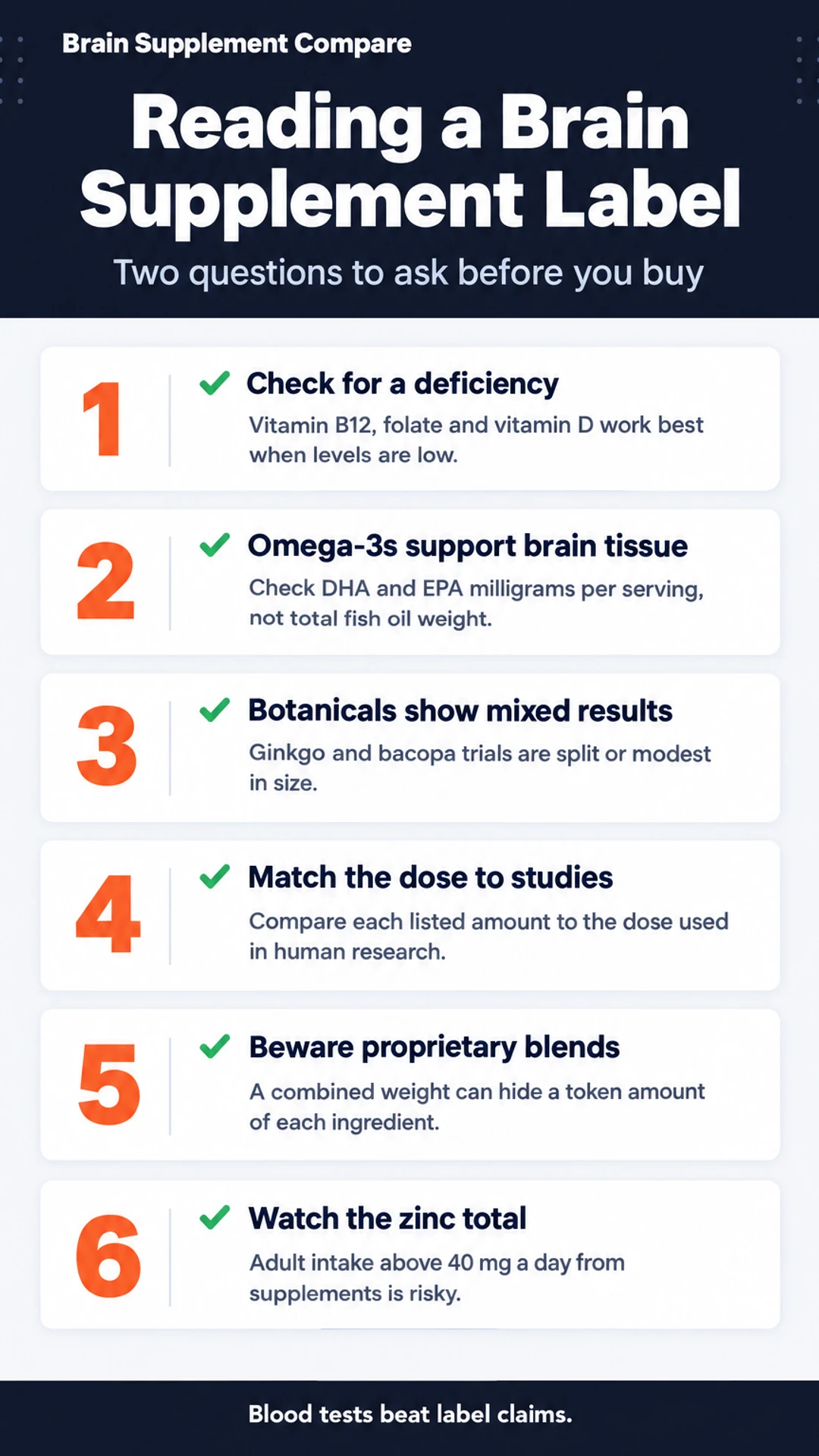
Reading a label well comes down to two questions: is the amount in the product close to what a study used, and is the claim being made about a deficiency you might have or about healthy brains in general? Those are different questions with different answers, and most of the confusion around brain supplements comes from blurring them.
You will also see the same ingredients in several other formulas on this site, including the hub comparison of Phytomem One against other options. The vendor's sales page describes Phytomem One as a 10-in-1 formula, and it lists ingredients such as saffron extract, berberine HCl and Ceylon cinnamon bark. Those are not named in the sales copy with amounts, and the reviewers I cite below say the same. So where it helps, we will use it as a case study in reading a label where the per-ingredient doses are hard to pin down.
Let's dive in.
Common ingredients at a glance
| Ingredient | Main evidence | Main caution |
|---|---|---|
| Vitamin B12 | Correcting a deficiency | Check serum B12 first |
| Vitamin D | Correcting low levels | Blood test beats label |
| Omega-3 (DHA, EPA) | Good support for brain tissue | Check milligrams per serving |
| Ginkgo biloba | Mixed trial results | Most products omit the amount |
| Bacopa monnieri | Modest, slow effect on memory | Stomach upset in some users |
| Saffron extract | Early, small trials | Dose rarely matches trials |
| Zinc | Deficiency impairs cognition | Over 40 mg a day is risky |
A closer look at each
Vitamin B12: Cobalamin supports myelin maintenance and the methylation cycles that neurons rely on, so it matters most when a deficiency is present. Adults over 50 absorb it less efficiently from food because of reduced stomach acid, and in those with low levels, correcting the deficiency is where the clearest cognitive benefit shows up. Check serum B12 before assuming a supplement will help your memory.
Folate and Vitamins B6 and B12 Together: Many brain formulas bundle these three, mainly to lower homocysteine. Trials of this combination have mostly tested people with elevated homocysteine or existing cognitive impairment, and results in healthy adults have been inconsistent. A label showing all three tells you the formula targets homocysteine, not that it sharpens recall in people with normal levels.
Vitamin D: Vitamin D receptors are present across brain regions, which is why it gets marketed for cognition. The evidence is strongest for correcting low levels, typically below about 20 ng/mL (50 nmol/L) in lab terms. Above that threshold, supplementing for memory has not shown consistent benefit in healthy adults, so a serum test tells you more than a label does.
Omega-3 Fatty Acids (DHA and EPA): DHA makes up a large share of neuronal membrane fat, and this is one of the better-supported brain nutrients. Most of the evidence comes from eating fish, especially oily fish two or more times a week, rather than from capsules. When you compare products, check the DHA and EPA milligrams per serving, not the total fish oil weight printed on the front.
Magnesium: It appears in many blends, but it matters mainly when dietary intake is low. Many adults fall short of the recommended intake of roughly 310 to 420 mg a day, depending on age and sex. Magnesium glycinate and threonate are the forms most often marketed for the brain, though the threonate form's advantage over others rests on animal and small human studies that are not conclusive. Check the elemental magnesium per capsule, since the salt weight on the label overstates the dose.
Zinc: Zinc is involved in synaptic signalling and is concentrated in some brain regions, so deficiency does impair cognition. Higher intakes carry real risks, though. Chronic intake above 40 mg a day from supplements can interfere with copper absorption and cause anaemia, and the upper limit is set at that level for adults. If a multi-ingredient product includes zinc alongside other minerals, add up the total to make sure you stay under that limit.
Ginkgo Biloba: One of the most studied botanicals, and the evidence is still split. Large trials in older adults with normal cognition have mostly found no benefit for memory, while some smaller trials in people with mild impairment or dementia reported modest gains. Standardized extracts, typically around 120 to 240 mg a day in trials, are what the studies used, so check the label for a standardized extract rather than a bare leaf powder. When you see ginkgo biloba on a brain product, ask how much is in it, because most products don't say.
Bacopa Monnieri: Common in memory-focused products, with a longer traditional history in Ayurvedic practice than most ingredients on this list. The clinical trials are modest in size and show the most consistent signal on memory acquisition and delayed recall, but the effect takes weeks, not days. Standardized extracts in trials have typically been dosed around 300 mg a day. Look for a standardized bacopaside content on the label, and expect stomach upset in some users.
Saffron Extract: Appears in newer proprietary formulas, and the research is early and mostly small. A few short trials have reported improvements in mild-to-moderate symptoms in small groups, and some work points to effects on mood. These are not large, long-term outcome studies, and nothing here shows saffron prevents cognitive decline. Note the extract type and dose, since trials used specific standardized preparations, usually in the tens of milligrams a day, and a formula rarely matches that.
Berberine and Banaba Leaf (Corosolic Acid): Both are best known for blood sugar effects, which is why I question their presence in a brain product. Berberine is studied mainly for glycemic control and lipids, and corosolic acid from banaba is studied for lowering post-meal glucose. Any cognitive link is indirect, through metabolic health, and not a direct brain effect. If you take glucose-lowering medication, these can add to its effect, so check with a clinician before combining them.
Cinnamon Bark and Citrus Extracts: Included in some formulas for their antioxidant profiles, such as Ceylon cinnamon bark and Morosil from Sicilian red oranges. The cognitive link is largely theoretical, based on lab and animal work that has not translated into solid human memory results. Antioxidant content in a capsule tells you little about what reaches the brain. Ask whether the product lists the amount of each extract, because a fraction of a gram of an extract is a different thing from a dose used in a study.
Reading a Proprietary Blend: The practical skill that protects you from paying for ingredients you cannot quantify. A proprietary blend lists a combined weight for several ingredients without saying how much of each is present, so a product can include a famous ingredient at a token level. Check whether each ingredient has its own amount, whether that amount matches a dose used in human research, and whether the label names the extract type. The Phytomem One sales page lists its ingredients, but a reviewer noted in a 60-day test that the exact amount of each is not disclosed, so apply the same check to it and to any other product before buying.
Frequently asked questions
What is the best vitamin for your brain?
No single vitamin is best for everyone. Vitamin B12 matters most when a deficiency is present, since low levels are linked to memory and mood problems. Folate and B6 work alongside it. Omega-3 fatty acids, especially DHA, are a major structural component of brain tissue. Your diet, age, and blood levels should guide which one is worth addressing first.
Do brain vitamins actually work?
It depends on why you are taking them. In people with a documented deficiency, correcting it can improve cognitive symptoms. In adults with normal levels, the evidence for memory gains from standard vitamins is weak and inconsistent. Most large trials of multivitamins in healthy older adults show modest or no effect on memory. Read the study design before trusting a claim.
What vitamin cuts dementia risk by 40%?
No vitamin has been shown in reliable research to cut dementia risk by 40%. Claims with a figure that large usually come from a single small study, a subgroup analysis, or a misreported result. Some B-vitamin trials showed slowed brain shrinkage in people with high homocysteine, but not a 40% reduction in dementia. Treat any precise percentage without a named source with caution.
What are the best brain supplements for adults?
The better-studied options are omega-3s, vitamin B12 and folate where intake is low, and vitamin D when levels are deficient. Many multi-ingredient brain formulas combine herbal extracts with limited human data, and ingredient amounts are often undisclosed. Check the dose of each ingredient against published research, and ask your doctor about interactions if you take medication or are over 65.
Are brain vitamins safe for older adults?
Most standard vitamins are safe at typical doses, but higher doses carry risks. Fat-soluble vitamins can build up, and some herbal extracts interact with blood thinners, blood pressure drugs, or diabetes medication. Older adults often take several medications, which raises the chance of an interaction. A pharmacist can review a label against your current prescriptions in a few minutes.
Wrapping up
That covers all 12 brain vitamins and ingredients, each with the evidence behind it.
Most of the research is strongest for correcting a deficiency, and weaker for boosting memory in people who are already well nourished.
Which one will you try first, or is there one I missed?
If you want to look at a specific product, Visit the official site to read the vendor's own description of Phytomem One.